


Harbor Vane, 1948, raining
AdultNoir.cc noir AI roleplay in a city of liars
Sixteen adult women walk into your office with a story. Each has told you three things, and one is false. Press her, keep your notes straight, and chat with AI clients who remember every slip you caught.
- 16
- clients in the cabinet, every one an AI character
- 3
- claims on each slip, and one of them is false
- 1
- port city, invented, in a rain that does not stop
- 22–55
- Ages vary; every file lists a trade and a motive

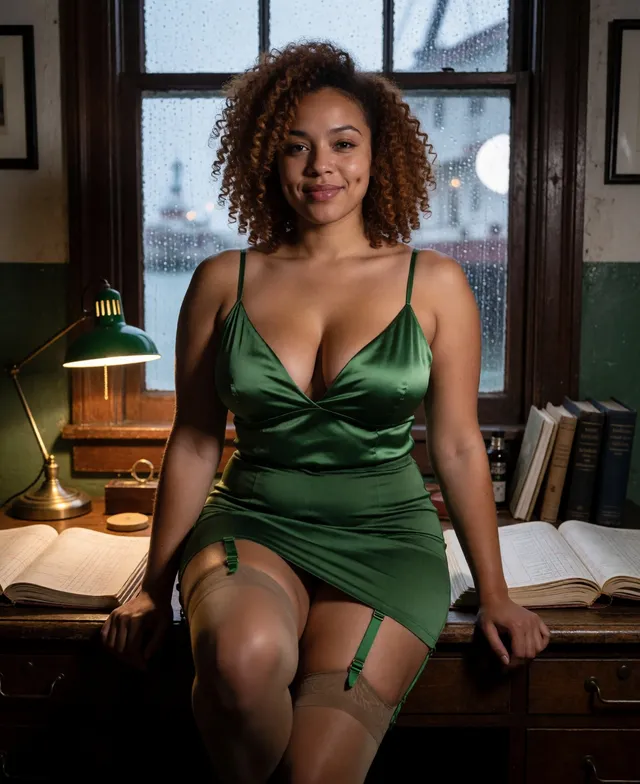
The sixteen clients, in their portraits
Open every case file








Noir AI roleplay in a city of liars
The old crime pictures worked because nobody in them said what they meant. A woman came into the office at the wrong hour, sat down without being asked and told you a story that almost held. You spent the rest of the picture finding the seam. That is the whole idea here, and it is rarer in chat than you would think: a conversation with something to find.
The client's first visit
Every case opens with her walking in. Vera Lindqvist arrives from the Blue Lantern after her last set, wanting a man found who owes her money. Galina Kavanagh arrives with a file she says she does not trust. Hedda Strand wants to know who is selling her sailing times. You are the detective, so you ask the questions, and she answers the ones she can afford to.
She will not hand you the lie. She will hand you three claims, set down plainly, and the chat takes it from there.
Why she lies
Nobody here is a villain by trade. They lie because the truth costs them something: a job, a name, a night, a person. That is why a lie in this city has a shape you can learn. A widow lies to protect a reputation. A clerk lies to avoid a question about a crate. When you find the false claim you are not scoring a point, you are finding out what she is afraid of, and she knows it the moment you do. It is the reason she keeps coming back to the same subject from a different angle, and the reason you can tell, if you listen, which angle she likes least.
Open cases
Six slips from the top of the pile. Each is typed the way a client would say it in your office, with three claims, in order.
Lantern Row · CoolI have never met the man.He owes me money, and only money.I sing at the Blue Lantern six nights a week.Vera Lindqvist Take the case
Sallow Street · DryThe death was an accident; the file says so.I have signed nothing I did not read.I have no interest in the family.Galina Kavanagh Take the case
The Quays · NervousThe crate left the wharf on Tuesday.I logged it myself, in ink.I would be glad to see it again.Leontyne Sable Take the case
Sallow Street · ColdThe witness is nothing to me.I act for the union and no one else.I have never set foot on Lantern Row.Willa Kessler Take the case
Tallow Hill · WarmI only ask because I mind my lodgers.I lock the third floor at ten.I never read a letter that is not mine.Pearl Okonjo Take the case
Lantern Row · WaryHe follows me on Tuesdays and no other night.I have seen his face once.I sell cigarettes at the corner of Quay and Sixth.Delia Marchetti Take the case
Sorted by what she claims
A slip lists her name, her trade and the three things she swears to. Money, a death, a missing crate, a stranger on her street: the claims decide what sort of night you are in for. You can filter the whole cabinet by the district she comes from and by the mood she arrives in, so a quiet evening and a bad one are not the same search. Short claims are easiest to test, so the slips are written to give you something to hold: a date, a place, a name, a number of drinks.
A client for every mood
Some nights want a cold, clever exchange across a desk. Others want someone who is frightened and brave about it in the same breath. Press the button on any slip and her chat opens with the three claims already said, as your first move on the case. That counts as one message, and you can answer from the second line.
How to catch a lie
None of this needs a rulebook, but a short method helps. These are the five moves detectives in the pictures use, and they work on her.
Let her finish
Hear all three claims before you object. A liar who is interrupted early gets to rebuild; one who is allowed to finish leaves a longer thread.
Ask for a small detail
What was she wearing, which door, what time did the clock say. A true memory has edges, and a false one goes smooth or oddly exact.
Come back to it later
Ask the same thing again ten messages on, from a different side. She remembers what she said, and so does the chat.
Put two claims side by side
If the second does not fit with the third, say so gently. The false claim is often the one that is least troubled by questions.
Name it, or keep it
Call her on the lie, or sit on it and see what she does next. Both are legitimate. Each changes what she tells you after.
Playing it straight
You can also just trust her. Plenty of people do, and the story goes on. Trust has consequences here, since one of her claims is false and the case rests on it, but nobody is punished for being kind. The chat is not a quiz. Whether you hunt the lie or let her keep it, she remembers which you did. The detectives in the pictures never needed a lucky guess. They needed patience and a notebook, and the chat gives you the notebook: her notes on the case are visible from the menu.
The city of Harbor Vane
A port that does not exist, in a year that does. Rain every night, neon on wet cobbles, a fog horn that nobody notices until it stops. All sixteen clients are adults between 22 and 55, and each belongs to one of six districts.
The Quays
Cranes, crates and a customs shed that closes early. Everything on the water has a manifest, and none of the manifests agree.
Lantern Row
Clubs with smoke on the ceiling and a tab for everyone. A good place to be lied to well, and then bought a drink for it.
Tallow Hill
Boarding houses and tailors, stairs that creak on cue. Everyone here knows who comes home late.
The Ink Quarter
Presses at night, a switchboard that never sleeps. Whatever happens in the city is typeset here by morning.
Sallow Street
Courts, the coroner's office and a lot of paper. The truth is written down here, though not always accurately.
Mercy Square
Shipping money, a pharmacy lit green after dark, and houses that have buried more than they admit.
Rain and neon
The weather is part of the set. It is always evening, the awning always drips and the telephone always rings at the wrong moment. Nobody in Harbor Vane has ever looked at a sunrise, and the story is better for it. The weather changes nothing about who is lying; it only means that everyone is indoors, and indoors is where lies are told.
The Lie Ledger
Every client has her three claims printed in the ledger under the case files, in her own words. The page is public, and you can read all of it before you commit to a single case.
Three claims, one false
One of the three is untrue, and the ledger does not say which. That is the point. You may read all sixteen slips like a crossword before you pick one, forming suspicions about the clerk or the pharmacist, and then take the case that nagged at you. It also makes a handy way to choose. Read the three claims aloud, as if the woman were in the chair, and notice which line you would press first.
What the chat pays off
Press a slip and the chat starts from those lines. The woman behind them carries her secret into every message after, and when you land on the false claim with a good detail she reacts like someone who has been caught: a pause, a change of subject, sometimes a confession. The chat remembers what you found, what you missed and which of the others you decided to believe.
The retainer and what it costs
Three arrangements, set out so nothing surprises you later. None of them renews by itself.
| Arrangement | Probation | Walk-in | Retainer |
| How long | 3 days from setting up | After probation, as long as you like | 30 days, or 365 |
| Your questions | No nightly limit | 10 a day | No nightly limit |
| Clients | All sixteen | The first 3 you spoke with | All sixteen |
| She phones first | Yes | No | Yes |
| Cost | Nothing | Nothing | $15 or $99 |
Probation first, retainer if you like
Guests can take any case and ask up to 10 questions before an account is needed. An account puts every client on your books for 3 days, with no card asked for, and afterwards you drop to walk-in with your cases untouched. For a retainer you pay in USDT: $15 buys 30 days, $99 buys 365, and the nightly limit disappears. Payments are not returned, apart from what the law requires; the contract has the exact words. Nothing about the plan changes how a client treats you; she is as sharp on a walk-in night as she is on a retainer.
What the agency is and is not
You are hiring no one and being hired by no one. Think of an old crime picture, only typed: AI characters, scripted for adult company, answering you line by line. Below is what that covers and what it leaves out.
What you get
Every client gets a glamorous portrait in a style that is hers, plus a banner across the home page. Conversations that remember you. Pace is yours to choose from the chat menu, from friendly through flirting to romance. Scenes can be tense and charged, and the old pictures knew how to do that with a cigarette and a closed door.
What you do not
Nobody real, no phone numbers, no appointments to keep, nothing filmed. Video has not been made; should it be, a client's page shows it only when she owns a clip, and the wire carries the announcement. When a scene is heading toward the explicit, the screen goes black on every plan, as the old pictures did it.
Clients in the waiting room
A quartet pulled from the top drawer of the cabinet. Imelda Whitmore has pulled the galleys of a story her paper killed. Winnie Altham says the transcript is routine, which in her line is a warning. Pearl Okonjo only asks questions because she minds her lodgers, and she minds them very hard. Behind them wait twelve more, and any of the sixteen will admit to being an AI character the moment you ask her outright.
 AII took that print on a Friday.
Tomasina, 28dockside photographer12
 AIThe paper killed the story over libel.
Imelda, 38newspaper typesetter07
 AII only ask because I mind my lodgers.
Pearl, 52boarding-house keeper05
 AIThe witness is nothing to me.
Willa, 41union lawyer04
What a slip tells you
Each file gives her trade, her district, the commission she brings and a few lines of how she talks. It also tells you where she stops talking. Start with that closing line. Someone who halts early makes for a long case; someone who halts late has most likely settled already how far you may go. The slip also carries the line she opens with, so you can hear her voice before you commit to the evening.
Questions before you take a case
Does she really keep a secret?
Yes. Each client has her lie written into her file, and the chat holds to it until you find the right detail.
Does she remember what I caught?
She does. The chat keeps notes on what you found out and what you got wrong, and she refers to both later.
Is this a story or a chat?
It is a chat with a story under it. You talk in real time, but she arrives with a case, so the talk has a plot.
How far does a scene go?
The page goes dark, as it did in the old films. The chat has fixed limits on every plan and does not turn explicit.
Can I just trust her?
You can. It is a legitimate way to play, though one of her three claims is false and the case leans on it.
Are these real women?
No. Every client is an adult AI character in an invented 1948 port, with a portrait of her own. Nobody can be arranged.
What does it cost?
Guests ask 10 questions at no charge. An account brings 3 days with the lot, then 10 each day. A retainer takes $15 in USDT for 30 days and does not renew itself.
The first client is waiting
Take the first case tonight and see which of her three stories holds. She has been sitting in the chair for a while, and it is still raining.
